
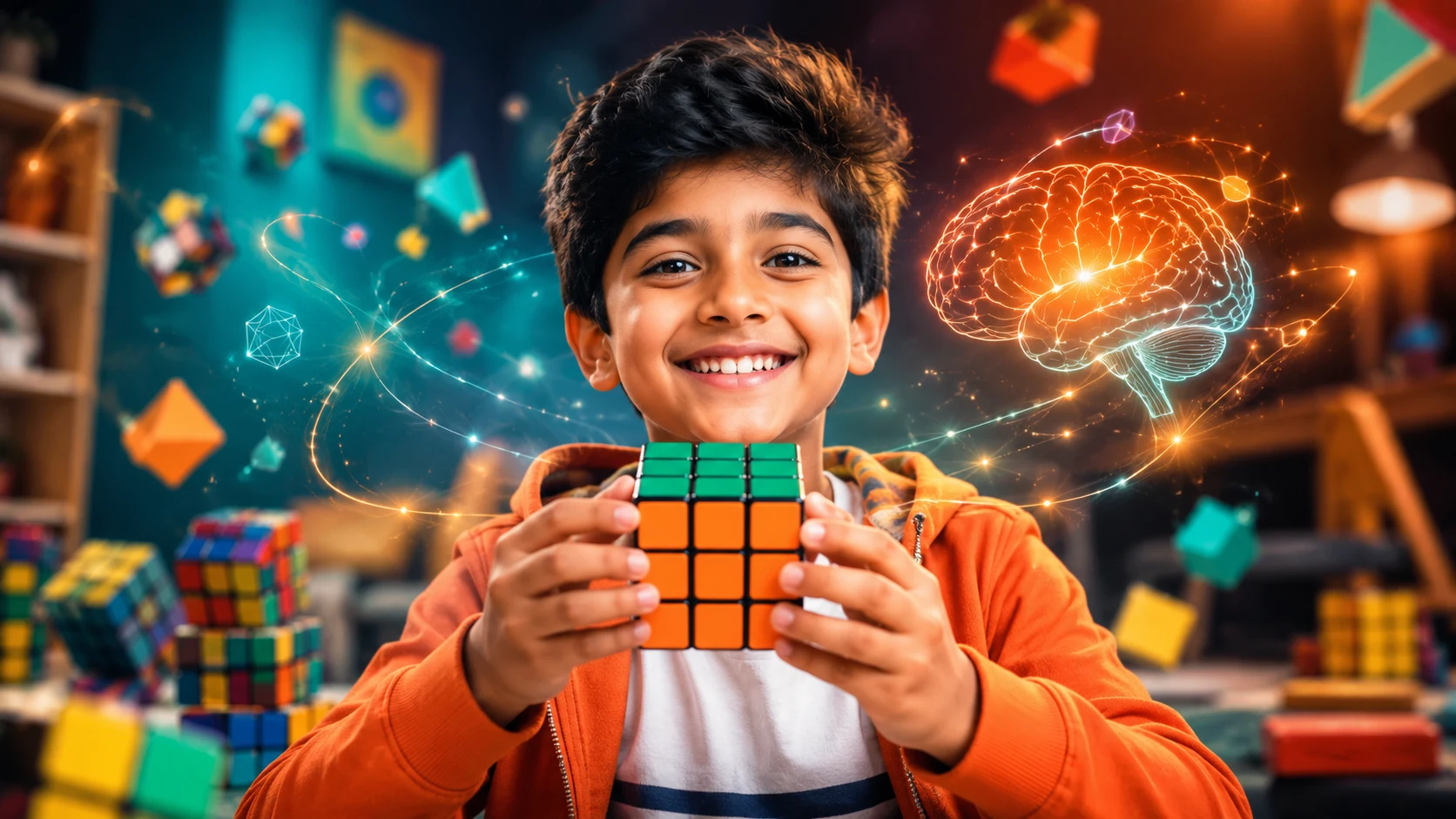
In a world dominated by screens, the Rubik's Cube offers a refreshing, tangible challenge that builds essential cognitive skills. More than a puzzle, it's a complete brain workout that develops multiple intelligence domains simultaneously. Invented in 1974 by Hungarian sculptor Ernő Rubik, this simple-looking cube has become one of the world's most popular puzzles—and for good reason.
The Cognitive Science Behind the Cube
When a child attempts to solve a Rubik's Cube, they engage in a sophisticated mental process that involves memory, pattern recognition, spatial reasoning, and sequential planning. Brain imaging studies show that cube solving activates regions associated with working memory, spatial intelligence, and executive function—the same areas used in complex mathematical reasoning and logical analysis.
Unlike passive entertainment, solving the cube requires active problem-solving. Each twist and turn is a deliberate decision based on an understanding of how that move affects the overall configuration. This deliberate practice builds neural pathways that enhance overall cognitive function.
Logical Thinking
Solving a Rubik's Cube requires breaking down complex problems into smaller, manageable steps—the very essence of computational thinking and algorithmic reasoning. Students learn to identify patterns, apply algorithms, and systematically work toward a solution. These are the same skills that power computer programming, scientific analysis, and mathematical proof.
Our instructors teach multiple solving methods, starting with the beginner's Layer by Layer method and progressing to advanced speed-cubing techniques like CFOP (Cross, F2L, OLL, PLL). Each method represents a different approach to problem-solving, giving students a toolkit of strategies they can apply to any challenge.
Pattern Recognition
The cube trains the brain to recognize patterns and develop algorithms, skills that transfer directly to mathematics, coding, and scientific reasoning. Advanced solvers don't see random colors; they see configurations they've encountered thousands of times. This ability to recognize patterns amid apparent chaos is a hallmark of high-level thinking in any domain.
Patience and Perseverance
Unlike digital games that offer instant gratification, the Rubik's Cube teaches children the value of persistence. Each solved cube represents hours of practice and the satisfaction of overcoming a challenge. Students learn that failure is not defeat but a stepping stone to mastery—a lesson that serves them well in all endeavors.
Parents consistently report that their children become more patient and persistent after learning the cube. They're less likely to give up when faced with difficult homework problems and more willing to work through challenges step by step.
Spatial Intelligence
Manipulating the cube develops spatial awareness—the ability to visualize and manipulate objects in three dimensions—a critical skill for engineering, architecture, design, and many STEM fields. Students who can mentally rotate and manipulate the cube develop superior spatial reasoning abilities that translate directly to geometry and trigonometry.
Research shows that spatial intelligence is one of the strongest predictors of success in STEM fields. By developing this capacity through cube solving, children build a foundation for future achievement in science, technology, engineering, and mathematics.
Memory Enhancement
Solving the cube requires memorizing sequences of moves—algorithms—and knowing when to apply them. Advanced solvers may memorize hundreds of algorithms. This memory training strengthens both short-term and long-term memory capacities, with benefits that extend to academic subjects.
Our students regularly report improved memory in school subjects after learning the cube. The mnemonic techniques they develop for remembering algorithms transfer to remembering formulas, vocabulary, and historical facts.
Digital Detox
With rising concerns about screen addiction, the Rubik's Cube offers a healthy alternative that engages the mind without the harmful effects of excessive screen time. It's portable, requires no batteries or internet connection, and provides a satisfying tactile experience that screens cannot replicate.
Competition and Community
The Rubik's Cube also opens doors to a vibrant global community. Speed-cubing competitions are held worldwide, with categories for all ages and skill levels. Our students participate in district, state, national, and international competitions, developing sportsmanship, confidence, and a sense of belonging to a global community of puzzle enthusiasts.
At I-Genius, our Rubik's Cube course takes students from complete beginners to speed-cubing competitors, developing these skills in a structured, supportive environment. Whether your child wants to solve the cube for fun or compete at the highest levels, we provide the training and support they need.